 |
|
|
|
|
|
|
|
|
|
|
 |
|
|||||||||
 |
 |
 |
|
|||||||
 |
|
|||||||||
 |
 |
 |
 |
 |
 |
 |
 |
|
||
 |
 |
 |
|
|||||||
 |
|
|||||||||
On the sixteenth day, he stepped on a landmine in the suburbs of Baghdad. The explosion ripped apart his left foot, “You might look at that big number, that 500 dead, and say ‘God, that’s horrible,’ ” he says, his eyes coming alive behind steel-rimmed glasses. “But really, those were guys that had to shoot at us first. You shoot at me or my friends and it’s on, that’s no joke.” He pauses and spreads his arms. “I look at that number and say, ‘Wow. That’s Impressive.’ ” His face still marked by a boyish charm at the age of twenty-three, Garth (GS ‘09) constitutes a growing breed at Columbia: he is one of the twenty-seven military veterans in the School of General Studies’ freshman class. As students smoke cigarettes on the marble steps outside of Butler Library and grumble about their latest all-nighter, Garth lets out a knowing smile. Oh, how little they’ve suffered. Still, he is lucky. The fake leg “doesn’t slow him down much,” laughs his younger brother Corey Stewart, a cook in the Navy. “We’ve got pictures of him drinking beer out of his prosthetic leg.” Garth, always the good soldier, wants pity from no one. “There are some of these guys that act like they demand respect because they got wounded,” explains Corey, “which, you Garth wanted risk. “If I was going to join the army,” says Garth, “I really didn’t want to be like a health specialist or an accountant or something. I wanted to be the guy throwing grenades and shooting a rifle.” One day, as PFC Stewart stood outside a factory amidst a lull in the battle of Baghdad, a muzzle flash appeared in a nearby patch of trees. Three impacts on the factory wall followed along the level of his head. Whoosh. A bullet zipped past his nose. “Get down! I see him,” he yelled, taking aim with his rifle at the flash. He squeezed the trigger. Pop. Pop. The shooting stopped. Of all the battles he had fought, this was the closest Garth could say for certain that he had shot a man. The majority of fighting was done from a distance, using the 120-mm cannon that he named ‘Utopas’—a Greek word meaning ‘no man’—from a tank named ‘Evil Betty.’ Fire Direction Control would give the order: Convoy X is under attack. Fire here. Boom. Adjust. Boom. Adjust. Boom. “You’ll get tiny, minute adjustments” Garth explains, holding two fingers together, “and you’ll walk the round onto the enemy position.”
“What soldiers have to do is an important issue to talk about,” says Peter Awn, Dean of the School of General Studies. “Killing people is killing people. How do you determine ethically who is right to do something like that?” Garth doesn’t seem too bothered. Popping french fries into his mouth at the West End, Garth thumbs through a leather-bound picture book. It contains a bizarre smattering of photos from Iraq, some of friends in full battle gear, others of charred bodies in still-smoldering trucks. Unflinching, Garth tells the story of each picture. Oh yeah, this is me in a tank. Next photo. These are some guys we killed. Next photo. Garth, the eldest and most erudite son of two former Marines from Stillwater, Minnesota, still firmly believes—for better or worse—in the romance of war. “Insomuch as there is a good way to die,” says Garth, remembering the friends he lost, “in open combat, that’s it.” At a reunion this past October for “graduates” of the Army’s Walter Reed Medical Center, Garth moved easily through the crowd, picking his way through the Army’s top brass and the war’s most recent casualties. “Garth is a phenomenon,” explained Colonel Jeff Gambel, a surgeon at Walter Reed. “The average person with his injuries is in the hospital for weeks and months, but after three weeks, Garth was gone.” In fact, on June 22nd, 2003, less than three months after having his leg amputated, Stewart rejoined his infantry platoon back in the U.S. “Garth is a rock star,” laughed former Deputy of Secretary of Defense Paul Wolfowitz, patting him on the arm. He and “There was only two things I worried about when I was on the hospital bed: athletic prowess and vanity.” As Garth tells the story, a wry smile emerges on his face. He brushes a lock of hazel-colored hair from his forehead, still smiling. “I didn’t understand, ‘what are girls going to think?’ ” On his first weekend home from Iraq, Garth went for a run; the next weekend he got laid. And with that, his worries were assuaged. Not all the war’s casualties have been so lucky. At the reunion in Washington, a few feet from Garth and the Generals, a group of three veterans quietly commiserated and took refuge —however transient—in each other’s company. Two had sustained head injuries, eliminating their capacity for short-term memory, and the third suffered from a slight limp and a crippling case of Post-Traumatic Stress Disorder. Not one among them was older than twenty-two. “If you got shot, you were in Afghanistan,” explained one of the vets, his voice slightly vacant. “If you got hit by an IED [Improvised Explosive Device], you were in Iraq.” The young man’s gaze gets lost for a moment. Catching himself, he says, “We were all in Iraq.” “At home,” explained veteran Colton Aikin, “no one understands, no one understands what I went through, no one’s changed, but I’ve changed. Here [among the wounded veterans] people understand…I just, I don’t know how much longer I can do this.” Later, when asked, Garth mused on their fate, touching his chin. “They think about what happened to them when they got hurt and they’re not able to shake that thought. They’re lost in that thought.” He sounds puzzled by this, unable to empathize. “It’s like they keep injuring themselves again and again and again in their minds.”
But in the big picture, as Garth knows, he’s pretty well off. “A below-the-knee amputation is more or less superficial,” he explains, unblinking. “Sacrifice isn’t a bad thing. If you can get hurt and make something good happen because of it, who gives a shit?” For is own part, Garth now dreams of becoming a history teacher and a politician. “Country is important to me,” he declares. But that is only part of the story. Garth left Iraq when the war was still new and shiny, before IEDs, before Fallujah, before even the insurgency itself, and it shows. When asked about civilian casualties, he talks about a group of Iraqi peasants that greeted his platoon by lining a roadway to wave at the Americans. Troops from the Fedayeen Saddam spotted the villagers and aimed an artillery barrage at them, killing dozens of innocent people. Garth’s platoon fired back, destroying the enemy. “I can personally say that because of my conduct, more hostile enemy soldiers died and more civilian lives were saved,” smiles Garth, “and that makes me happy.” But the margin is razor thin. Garth tells two stories. In one, a car is speeding toward his camouflaged tank during a sandstorm. The car crosses into the no-man’s land of proximity where the gunner is authorized to destroy the vehicle. Garth quickly peers through his riflescope and spots a man and a child in the car. Garth shouts over the radio to the rest of his platoon to hold their fire. Two innocent lives are spared. In the other story, the same thing happens to a different platoon. It is a sandstorm. The gunner, fearing attack and lacking binoculars, sprays the vehicle with machine-gun fire. The van rolls off the road into a ditch. Inside it, the soldiers discover the shredded bodies of a middle-aged man and an old woman. In the backseat, they unearth a gaggle of crying children bleeding from mortal wounds. The war may end, but their nightmares will linger. And the nightmares will be plenty: according to Iraq Body Count, U.S. soldiers killed 9,270 civilians during the first two years of the Iraq war. “I’d feel more comfortable calling it luck,” says Garth, “but some units make it through without doing the wrong thing, and that’s huge.” Early in the fall semester, before his old unit had come home from its second deployment, Garth spoke easily about spreading freedom and described, without a hint of irony, the potential of “a stable, prosperous democracy” in Iraq to “act in a predatory fashion on all the theocracies that surround it.” Now, his friends tell him that Iraq is not the same. “In 2003, when we crossed the border you could drive a hundred miles in a day, fight a battle in the morning, fight a battle at night. It was electrifying. You didn’t even need sleep.” Garth pauses “Nowadays,” he says, his voice falling flat, “you just drive, an IED goes off, maybe one guy gets killed. Everyone knows him, someone’s gotta write a letter home to his parents, and that’s all that happens.” “If you’re a soldier there now, you’re just securing yourself,” he continues, sounding doleful. “You know, what are you protecting? Well, you, that’s it. You’re there to guard U.S. soldiers, and that’s a shame.” Having been promoted to Specialist, Garth was medically retired from the Army on November 29th, 2004. “It’s a memory I cherish,” Garth says, peering into the distance, a smile reemerging on his face. “A war experience I compare to a warm blanket. You wake up in the morning and there’s a couple of seconds where you don’t remember who you are, then I remember. ‘Oh yeah, I’ve been in a war, I go to Columbia.’ I pull the blanket over me for a couple more seconds. It feels great.” |

 morphing it into the shape of a rose—a burnt and bloody rose. Now, as he ambles down College Walk with his steel prosthesis, he exudes an unassuming, almost scholastic air.
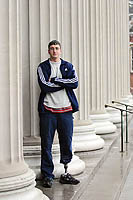 know, in a lot of ways they do. But in a lot of ways it was a risk we all take doing whatever the fuck it is we do.”
 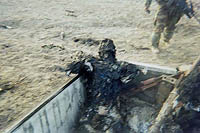 He pauses, bringing a closed fist to his mouth. “Once you fire on a position and move through it, it wasn’t uncommon to see lots of dead bodies.”
  “Doctor Wolfowitz,” as he calls the new World Bank President, became friends during Garth’s stay at Walter Reed. Since then Garth has returned on several occasions to lift the spirits of injured soldiers and Marines.
 PFC Stewart had his own dark days, but Garth barely acknowledges them. A Washington Post article from July 2003 depicted him as a “miserable ball of blue pajamas,” saved from debilitating stomach cramps after his surgery by, of all things, the caffeine of a Mountain Dew.
 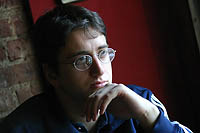 on this point, his eyes beaming with pride.